Voltage Source
Any device that produces a continuous voltage output is known as a voltage source. There are two types of voltage sources, namely ; direct voltage source and alternating volt age source.
Direct voltage source
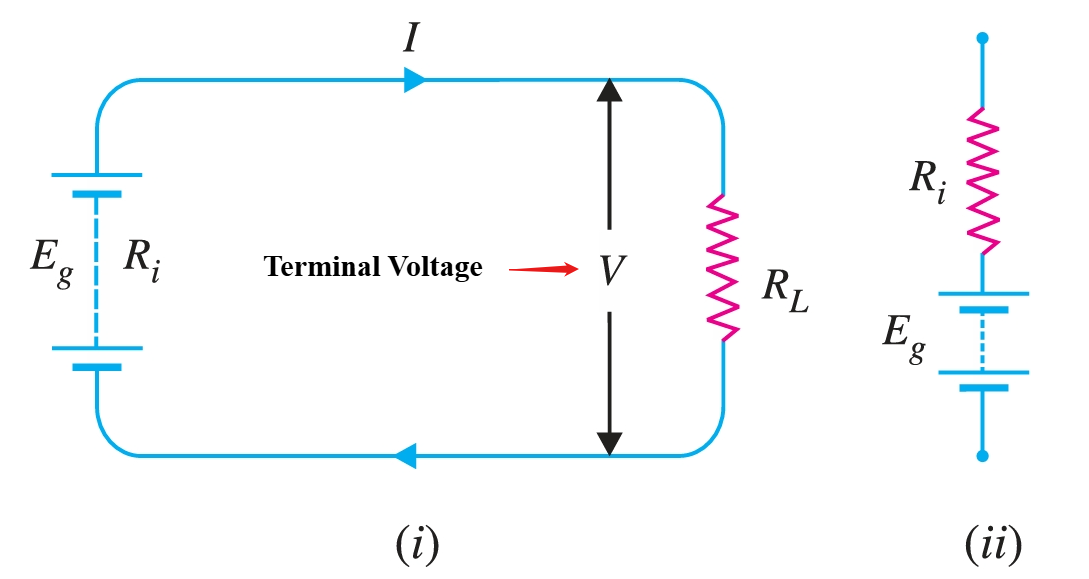
A device that produces a direct voltage output continuously is called a direct voltage source. Common examples are cells and d.c. generators. A key characteristic of a direct voltage source is that it maintains the same polarity of the output voltage; i.e., the positive and negative terminals remain constant. When load resistance RL is connected across such a source, current flows from the positive terminal to the negative terminal via the load. This is called direct current because it flows in only one direction. The current has one direction as the source maintains the same polarity of output voltage. The opposition to the load current inside the d.c. source is known as the internal resistance \(R_{i}\). The equivalent circuit of a d.c. source is the generated e.m.f. \(E_{g}\), in series with the internal resistance \(R_{i}\) of the source.
\[\text{Load Current, } I = \frac{E_{g}}{R_{i}+R_{L}} \]
\[\text{Terminal Voltage, } V = (E_{g} - IR_{i}) = IR_{L} \]
Alternating voltage source
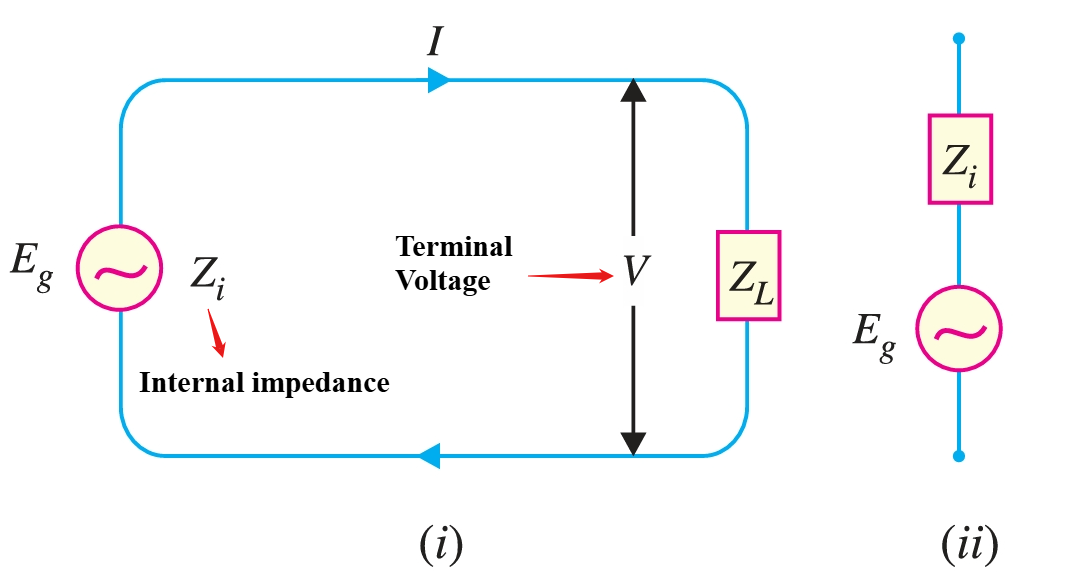
A device that produces an alternating voltage output continuously is known as an alternating voltage source, e.g., an AC source. generator. An important characteristic of an alternating voltage source is that it periodically reverses the polarity of the output voltage. When load impedance \(Z_{L}\) is connected across such a source, current flows through the circuit that periodically reverses in direction. This is called alternating current.
The opposition to load current inside the a.c. source is called its internal impedance \(Z_{i}\). The equivalent circuit of an a.c. source is the generated e.m.f. \(E_{g}~(r.m.s.)\) in series with internal impedance \(Z_{i}\) of the source.
\[\text{Load Current, } I(r.m.s) = \frac{E_{g}}{Z_{i}+Z_{L}} \]
\[\text{Terminal Voltage, } V = (E_{g} - IZ_{i}) = IZ_{L} \]
Constant Voltage Source
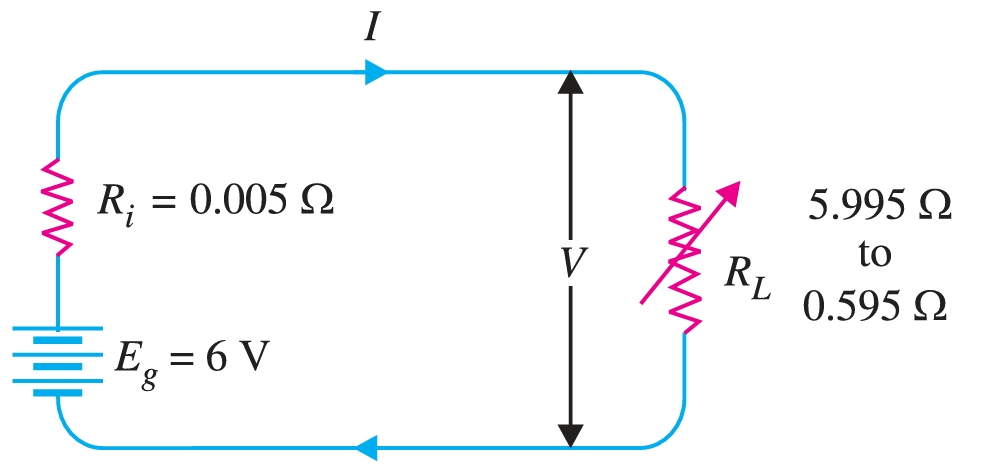
A voltage source with very low internal impedance compared to the external load impedance is known as a constant voltage source. In such a case, the output voltage nearly remains the same when the load current changes. In other words, the terminal voltage remains substantially constant, and the source behaves as a constant voltage source, irrespective of variations in the load current.
Constant Current Source
A voltage source with a very high internal impedance compared to the external load impedance is considered a constant current source. In such a case, the load current remains nearly constant when the output voltage changes.
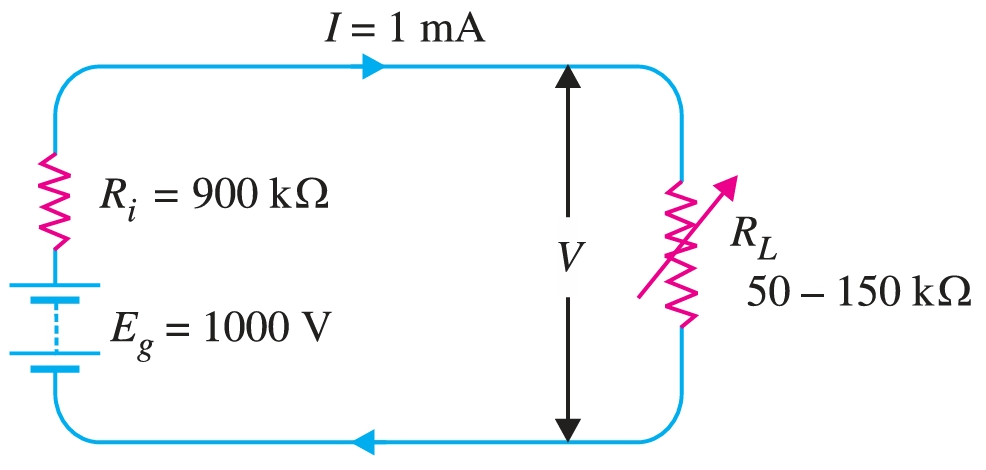
The following points may be noted regarding the constant current source :
- (i) Due to the high internal resistance of the source, the load current remains essentially constant as the load \(R_{L}\) is varied.
- (ii) The output voltage varies approximately in the same range as \(R_{L}\), although current remains constant.
- (iii) The output voltage \(V\) is much less than the generated voltage \(E_{g}\) because of the high \(IR_{i}\) drop.
This is understood from the following expressions:
\[\text{Load Current, } I = \frac{E_{g}}{R_{i}+R_{L}} \]
Since \(R_{i}>>R_{L}\),
\[I = \frac{E_{g}}{R_{i}}\]
and as both \(E_{g}\) and \(R_{i}\) are constants, \(I\) is also constant.
The symbol of a constant current source.