Introduction to Digital Electronics
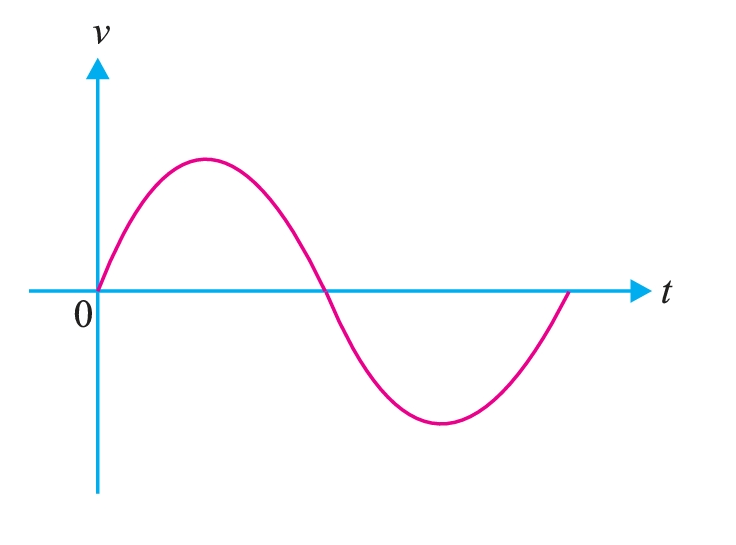
A continuously varying signal (voltage or current) is called an analog signal. For example, a sinusoidal voltage is an example of an analog signal. In the previous chapter, we studied the behavior of diodes and transistors primarily from the analog or continuous signal perspective. In an analog electronic circuit, the output voltage changes continuously in response to variations in the input voltage. In other words, the output voltage can have an infinite number of values. A signal (voltage or current) that can have only two discrete values is referred to as a digital signal. For example, a square wave is a digital signal. Semiconductor devices (e.g., diodes, transistors) can be designed for two-state operation, specifically saturation and cutoff. In that case, the output voltage can have only two states (i.e., values), either *low or high. An electronic circuit that is designed for two-state operation is called a digital circuit. Now digital circuits are being used in many electronic products such as video games, microwave ovens, and oscilloscopes. Digital techniques have also replaced a lot of the older *analog circuits* used in consumer products such as radios, TV sets and high-fidelity sound recording and playback equipment.
Analog and Digital Signals
Analog Signal
A continuously varying signal (voltage or current) is called an analog signal. For example, an alternating voltage varying sinusoidally is an example of an analog signal. If such an analog signal is applied to the input of a transistor amplifier, the output voltage will also vary sinusoidally. This is the analog operation, i.e., the output voltage can have an infinite number of values. Due to many-valued output, the analog operation is less reliable.
Digital Signal
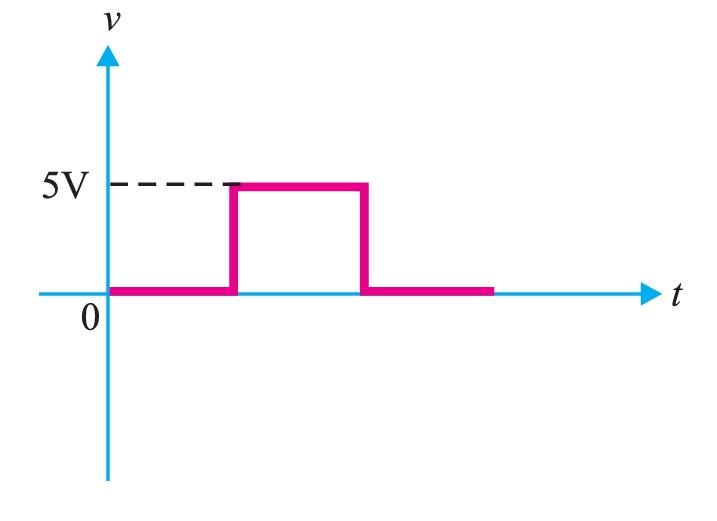
A signal (voltage or current) that can have only two discrete values is called a digital signal. For example, a square wave is a digital signal. This is because the signal has only two values, namely +5 V and 0 V, with no other values. These values are labelled as High and Low. The High voltage is +5 V, and the Low voltage is 0 V. If a proper digital signal is applied to the input of a transistor, the transistor can be driven between cut-off and saturation. In other words, the transistor will have two-state operations, i.e., the output is either low or high. Since digital operation has only two states (i.e., ON or OFF), it is far more reliable than many-valued analog operation. This is because with a two-state operation, all signals are easily recognized as either low or high.
Digital Circuit
An electronic circuit that handles only a digital signal is called a digital circuit. The output voltage of a digital circuit is either low or high and no other value. In other words, digital operation is a two-state operation. These states are expressed as (High or Low) or (ON or OFF) or (1 or 0). Therefore, a digital circuit is one that expresses values in the form of 1’s or 0’s. Hence the name digital. The numbering concept that uses only the two digits 1 and 0 is the binary numbering system.