Binary Number System
A number system is a code that uses symbols to count the number of items. The most common and familiar number system is the decimal number system. The decimal number system uses the symbols 0, 1, 2, 3, 4, 5, 6, 7, 8, and 9. Thus, the decimal system uses 10 digits for counting items. A binary system uses only two digits (0 and 1) for counting the items. The reader may wonder how to count the items in a binary system.
Counting in Decimal and Binary systems. Table 1 shows the counting of stones in the decimal and binary systems. As you will see, the counting in the binary number system is performed much the same way as in the decimal number system.
| Stones | Decimal | Binary |
|---|---|---|
| No stone | 0 | 0 |
| • | 1 | 1 |
| • • | 2 | 10 |
| • • • | 3 | 11 |
| • • • • | 4 | 100 |
| • • • • • | 5 | 101 |
| • • • • • • | 6 | 110 |
| • • • • • • • | 7 | 111 |
| • • • • • • • • | 8 | 1000 |
| • • • • • • • • • | 9 | 1001 |
- (i) Let us first see how items are counted in the decimal system. In this system, the count starts as 0, 1, …., 9. After 9, we are to write the next number. To do so, we use the second digit of the decimal system (i.e., 1) followed by the first digit (i.e., 0). So after 9, the next number is 10. The count again continues as 10, 11, 12 ….., 19. After 19, we use the third digit of the system (i.e., 2) followed by the first digit (i.e., 0) and the count continues as 20, 21, …. etc. In this way, we get the number up to 99. In order to represent a number next to 99, we use three decimal digits (100). That is to say, the second digit of the decimal system (i.e., 1) followed by the first two digits (i.e, two zeros).
- (ii) Let us now turn to the binary system. Note that 0 and 1 count in the binary system are the same as in the decimal system. To represent 2 stones, we use the second binary digit (i.e., 1) followed by the first (i.e., 0). This gives binary number 10 (read as one-zero and not ten) as an equivalent of 2 in the decimal system. Likewise, 3 in the decimal system can be represented by the binary number 11 (read as "one-one" and not "eleven"). After this, the two binary digits are exhausted. We shall use three digits to represent the next binary number. Thus, to represent 4 (four), we use the second binary digit followed by the first two binary digits. This gives the binary 100 (read as one-zero-zero) as equivalent to 4 in the decimal system.
- Each time the two digits 1 and 0 in one position are exhausted,
1is added at the left, all digits to the right are made0, and the count continues. - Each binary digit (0 or 1) is referred to as a bit. A string of four bits is called a nibble, and eight bits make a byte. Thus, 1001 is a nibble, and 10010110 is a binary byte.
- The binary number system is the most useful in digital circuits because there are only two digits (0 and 1).
Positional values
Consider the decimal number 642. This can be expressed as : \[642 = 600 + 40 + 2\] Note that in a multidigit decimal number (i.e., 642 in the present case), each position has a value that is 10 times the value of the next position to its immediate right. In other words, every position can be expressed as :
\[642 = 6 \times 102 + 4 \times 101 + 2 \times 100\]
Thus, we find that values of various positions in a decimal number system are powers of 10, i.e., equal to the number of digits used in the system. This number is called the base or radix of the system. Thus, the decimal system has a base of 10 (ten).
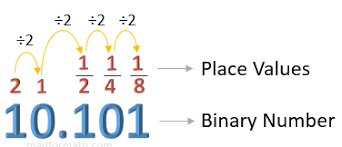
For the decimals, the digit to the extreme right is referred to as the least significant digit (LSD) because its positional value or weight is the lowest. For the decimal number 642, 2 is the LSD. The left-most digit in the decimal number is the most significant digit (MSD) because its positional value or weight is the highest. For the decimal number 642, 6 is the MSD with a value of 600.
In the binary number system, only two digits (0 and 1) are used. Therefore, the base of this system is 2. In a binary number, each position has a value that is 2 times the value of the next position to its immediate right. In other words, every position can be expressed by 2 raised to some power. We know that the binary number 1001 is equal to the decimal number 9. This can be readily shown as under :
\[1001 = 1 × 2^{3} + 0 × 2^{2} + 0 × 2^{1} + 1 × 2^{0} = 9\]
For binary numbers, the digit at the extreme right is referred to as the least significant bit (LSB).
In the binary number 1001, the 1 at the right is the LSB. The left-most digit is called the most significant bit (MSB). In the binary number 1001, the 1 on the left is the MSB with the value of 8 in decimal terms.
Decimal to Binary Conversion
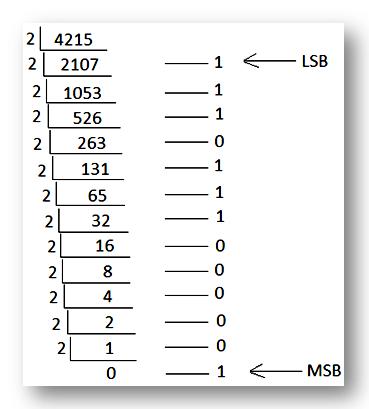
There are several methods for performing this conversion. The method described here is called double dabble because it requires successive divisions by 2. This method can be summarised as under :
- Divide the decimal number progressively by 2 and write down the remainder after each division.
- Continue this process till you get a quotient of 0 and remainder of 1, the conversion is now complete.
- The remainders, taken in reverse order, form the binary number.
Note that 13 is first divided by 2, giving a quotient of 6 with a remainder of 1. This remainder becomes the \(2^{0}\) position in the binary number. The 6 is then divided by 2, giving a quotient of 3 with a remainder of 0. This remainder becomes the \(2^{1}\) position in the binary number. Continuing this procedure, the equivalent binary number is 1101.
Example: Convert decimal fraction \((12.75)_{10}\) to its iquivalent binary fraction.
Solution: Convert decimal fraction \((12)_{10}\) and \((0.75)_{10}\) seperately to its equivalent binary fraction.
Convert decimal fraction \((12)_{10}\)
| Number divided by 2 | Quotient | Remainder |
|---|---|---|
| 12 | 6 | 0 |
| 6 | 3 | 0 |
| 3 | 1 | 1 |
| 1 | 0 | 1 |
Writing the Remainder in the reverse order \((12)_{10} = (1100)_{2}\).
Convert decimal fraction \((0.75)_{10}\).
| Fraction multiplied by 2 | Product | MSB |
|---|---|---|
| 0.75 | 1.50 | 1 |
| 0.50 | 1.00 | 1 |
| 0.00 | 0.00 | 0 |
Hence, the equivalent binary fraction of the decimal number \((12.75)_{10}\) is \((1100.11)_{2}\).
Binary to Decimal Conversion
Binary numbers can be converted to equivalent decimal numbers quite easily. Suppose you are given the binary number 110011. Its conversion to an equivalent decimal number involves the following two steps :
- (i) Place the decimal value of each position of the binary number.
- (ii) Add all the decimal values to get the decimal number.
Thus,
\[(110011)_{2} = 1 × 2^{5} + 1 × 2^{4} + 0 × 2^{3} + 0 × 2^{2} + 1 × 2^{1} + 1 × 2^{0}\] \[= 32 + 16 + 0 + 0 + 2 + 1 = 51\] \[∴ (110011)_{2} = (51)_{10}\]
In binary-to-decimal conversion, all positions containing 0 can be ignored. Only add the decimal values of the positions where 1 appears. Thus, in the case of the above binary number,
\[(110011)_{2} = 1 × 2^{5} + 1 × 2^{4} + 1 × 2^{1} + 1 × 2^{0}\] \[= 32 + 16 + 2 + 1 = 51\]