Light-Emitting Diode (LED)
A light-emitting diode (LED) is a diode that gives off visible light when forward biased.
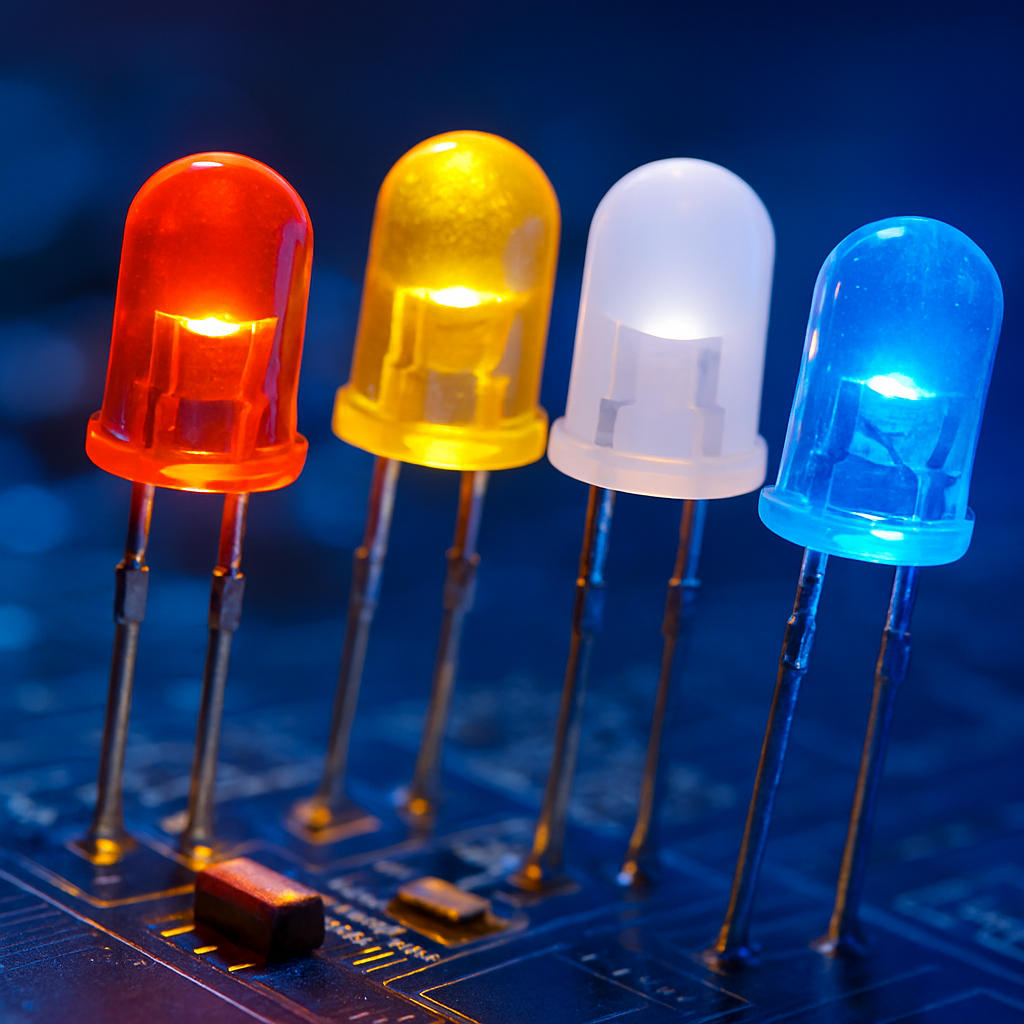
Light-emitting diodes are not made from silicon or germanium but are made by using elements like gallium, phosphorus and arsenic. By varying the quantities of these elements, it is possible to produce light of different wavelengths with colours that in clude red, green, yellow and blue. For example, when a LED is manufactured using gallium arsenide, it will produce a red light. If the LED is made with gallium phosphide, it will produce a green light.
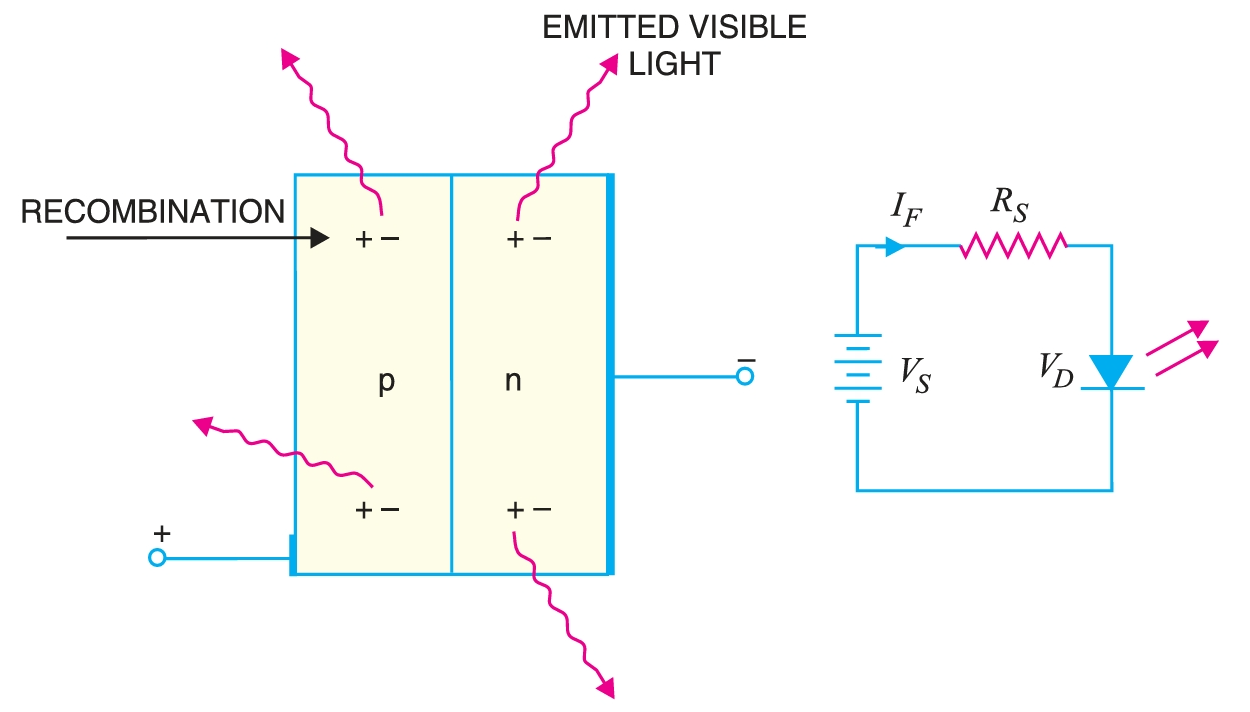
When light-emitting diode (LED) is forward biased as shown in Fig. 2, the electrons from the \(n\)-type material cross the \(pn\) junction and recombine with holes in the \(p\)-type material. These free electrons are in the conduction band and at a higher energy level than the holes in the valence band. When recombination takes place, the recombining electrons release energy in the form of heat and light.
In germanium and silicon diodes, almost the entire energy is given up in the form of heat and emitted light is insignificant. However, in materials like gallium arsenide, the number of photons of light energy is sufficient to produce quite intense visible light.
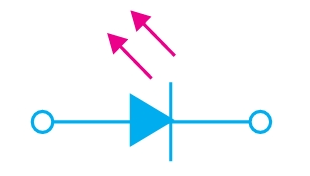
Fig. 3 shows the schematic symbol for a LED. The arrows are shown as pointing away from the diode, indicating that light is being emitted by the device when forward biased. The forward voltage ratings of most LEDs is from \(1~V\) to \(3~V\) and forward current ratings range from 20 \(mA\) to 100 \(mA\). In order that current through the LED does not exceed the safe value, a resistor \(R_S\) is connected in series with it as shown in Fig. 2. The input voltage is \(V_S\) and the voltage across LED is \(V_D\)
\[\therefore \hspace{1cm}R_S = V_S - V_D\] \[\therefore \hspace{1cm}I_F = \frac{V_S - V_D}{R_S}\]
Multicolour LEDs
A LED that emits one colour when forward biased and another colour when reverse biased is called a multicolour LED. It actually contain two \(pn\) junctions that are connected in reverse-parallel i.e., they are in parallel with anode of one being connected to the cathode of the other. If positive potential is applied to the top terminal as shown in Fig. 4, the \(pn\) junction on the left will light. The device current passes through the left pn junction. If the polarity of the voltage source is reversed, the pn junction on the right will light. The direction of device current has reversed and is now passing through the right pn junction.
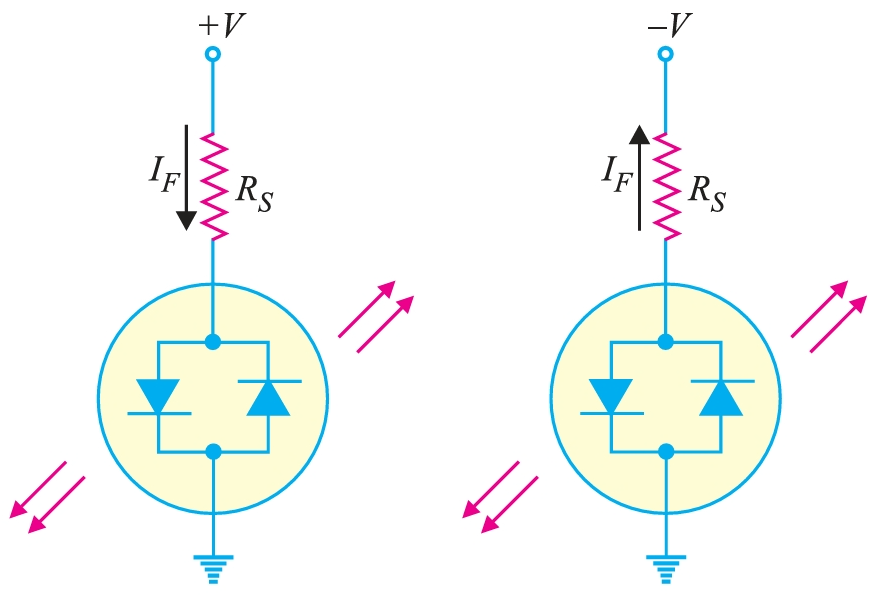
Multicolour LEDs are typically red when biased in one direction and green when biased in the other. If a multicolour LED is switched fast enough between two polarities, the LED will produce a third colour. A red/green LED will produce a yellow light when rapidly switched back and forth between biasing polarities.
Advantages of LED
The light-emitting diode (LED) is a solid-state light source. LEDs have replaced incandescent lamps in many applications because they have the following advantages :
- (i) Low voltage
- (ii) Longer life (more than 20 years)
- (iii) Fast on-off switching
Applications of LEDs
The LED is a low-power device. The power rating of a LED is of the order of milliwatts. This means that it is useful as an indicator but not good for illumination. Probably the two most common applications for visible LEDs are (i) as a power indicator (ii) seven-segment display (iii) Indoor and Outdoor Lighting and (iv) LED displays.
Power indicator.
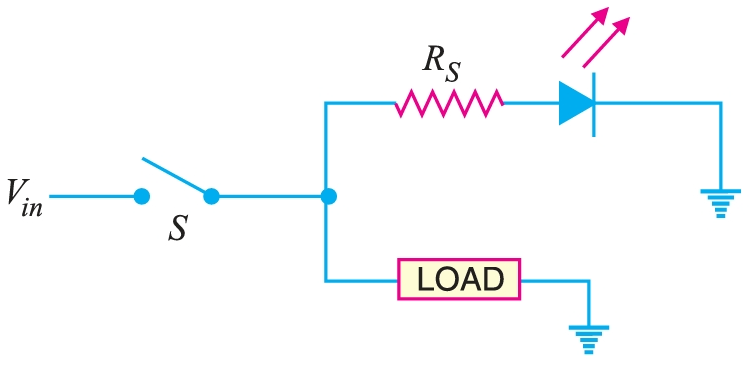
A LED can be used to indicate whether the power is on or not. Fig. 5 shows the simple use of the LED as a power indicator. When the switch \(S\) is closed, power is applied to the load. At the same time current also flows through the LED which lights, indicating power is on. The resistor \(R_S\) in series with the LED Fig. 5 ensures that current rating of the LED is not exceeded.
Seven-segment display
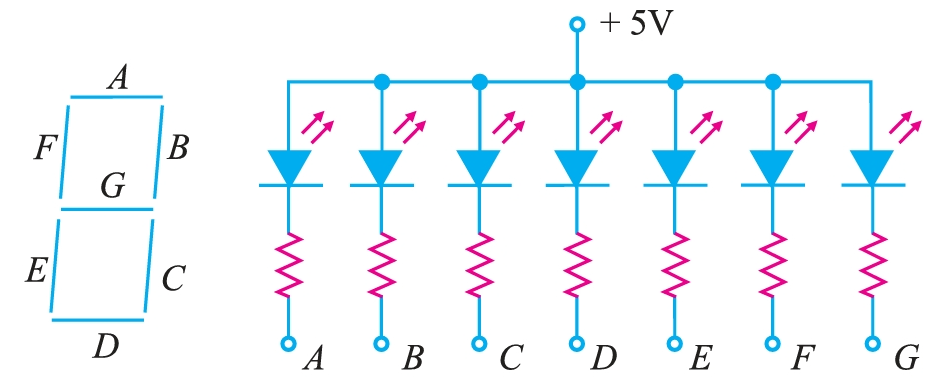
LEDs are often grouped to form seven-segment display. Fig. 6 shows the front of a seven segment display. It contains seven LEDs (\(A\), \(B\), \(C\), \(D\), \(E\), \(F\) and \(G\)) shaped in a figure of \(8\). Each LED is called a segment. If a particular LED is forward biased, that LED or segment will light and produces a bar of light. By forward biasing various combinations of seven LEDs, it is possible to display any number from 0 to 9. For example, if LEDs \(A\), \(B\), \(C\), \(D\) and \(G\) are lit (by forward biasing them), the display will show the number \(3\). Similarly, if LEDs \(C\), \(D\), \(E\), \(F\), \(A\) and \(G\) are lit, the display will show the number \(6\). To get the number \(0\), all segments except \(G\) are lit. External series resistors are included to limit currents to safe levels. The anodes of all seven LEDs are connected to a common positive voltage source of +5 V. This arrangement is known as common-anode type. In order to light a particular LED, the particular is grounded to complete the forward-biased circuit for the LED which makes it lit.
Indoor and Outdoor Lighting
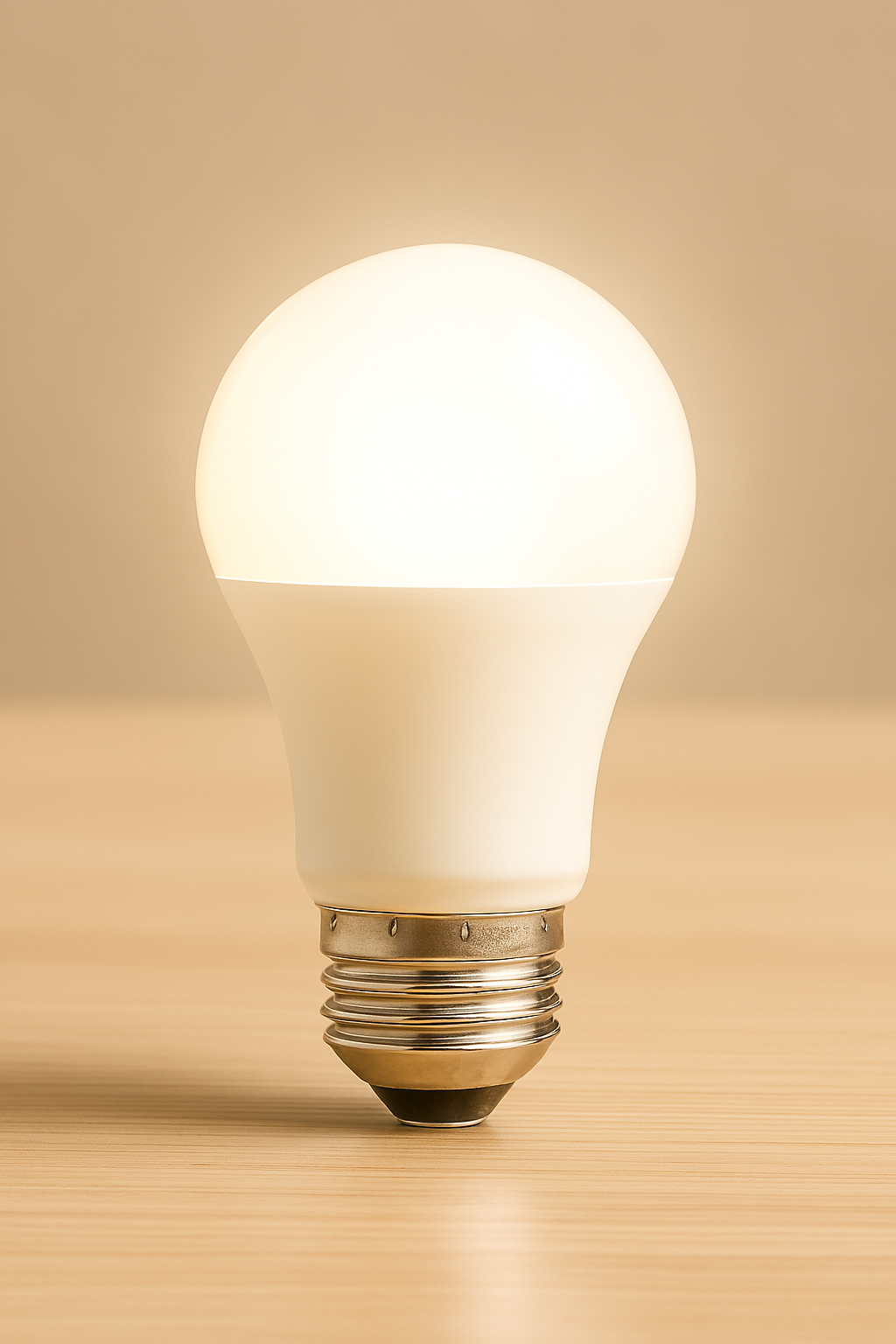
White light-emitting diodes (LEDs) have become the dominant technology in modern lighting due to their efficiency, longevity, and versatility. Commercially available white LEDs are produced using several approaches, each with distinct advantages.
The most common type is the phosphor-converted LED (pc-LED). In this design, a blue LED chip (typically based on GaN/InGaN) is coated with a yellow-emitting phosphor such as cerium-doped yttrium aluminum garnet (\(YAG:Ce^{3+}\)). The mixture of blue and yellow light appears white to the human eye. These LEDs are inexpensive, efficient, and widely used in general illumination, though they often have limited color rendering because of weak red emission.
Another approach is the multi-chip RGB LED, which combines separate red, green, and blue LEDs in one package. By adjusting the relative intensities, manufacturers can produce pure white light or tune the color temperature. RGB LEDs offer excellent color rendering and flexibility, but they are more complex to drive and can suffer from color imbalance over time.
LED Display
Recent developments include hybrid LEDs that use blue chips with multiple phosphors (green and red) or advanced materials like quantum dots and perovskites. These provide improved spectral balance, higher color rendering index (CRI), and tunable correlated color temperature (CCT). Such LEDs are increasingly used in displays, medical lighting, and applications requiring precise color fidelity.
An LED display is a flat panel display technology that uses light-emitting diodes (LEDs) as pixels to produce images. Each pixel is formed by one or more LEDs, which emit light directly when an electric current passes through them. Unlike LCDs, which require a backlight, LED displays are self-emissive, meaning they generate their own light. This property gives them high brightness, excellent contrast, and wide viewing angles.

LED displays are broadly classified into direct-view LED displays and LED-backlit LCDs. Direct-view LED displays are commonly used in large outdoor billboards, stadium screens, and indoor video walls. They consist of arrays of red, green, and blue LEDs that combine to produce full-color images. The pixel pitch (distance between LEDs) determines resolution; smaller pitches allow higher-definition images suitable for close viewing.
LED-backlit LCDs, on the other hand, use LEDs as a backlight source for liquid crystal panels. This improves energy efficiency, color quality, and thinness compared to older CCFL backlights.
The key advantages of LED displays includes, high brightness suitable for outdoor use, energy efficiency compared to traditional display technologies, long lifespan and durability and finally the flexibility in size and shape, enabling curved or modular video walls.
Applications range from advertising billboards, traffic signs, and stadium scoreboards to indoor video walls, televisions, smartphones, and laptops. With advances in micro-LED and OLED technologies, LED displays continue to evolve, offering higher resolution, better color rendering, and thinner, more flexible designs.