Teacher: Prof P. M. Sarun • NPHC206 • WINTER - 2025-2026 • Last updated:
Questions
In a common base connection, the current amplification factor is \(0.9\). If the emitter current is \(1\,\text{mA}\), determine the value of the base current.
In a common base connection, \(I_{C} = 0.95 \,\text{mA}\) and \(I_{B} = 0.05 \,\text{mA}\). Find the value of \(\alpha\).
In a common base connection, the emitter current is \(1\,\text{mA}\). If the emitter circuit is open, the collector current is \(50 \,\mu\text{A}\). Find the total collector current. Given that \(\alpha = 0.92\).
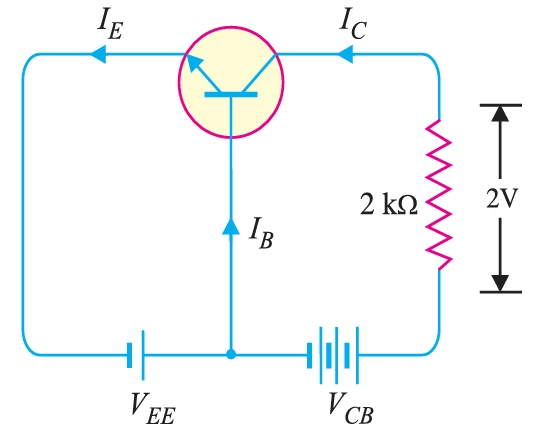
In a common base connection, \(\alpha = 0.95\). The voltage drop across \(2 \,\text{k}\Omega\) resistance, which is connected in the collector, is \(2\,\text{V}\). Find the base current.
Figure 1.
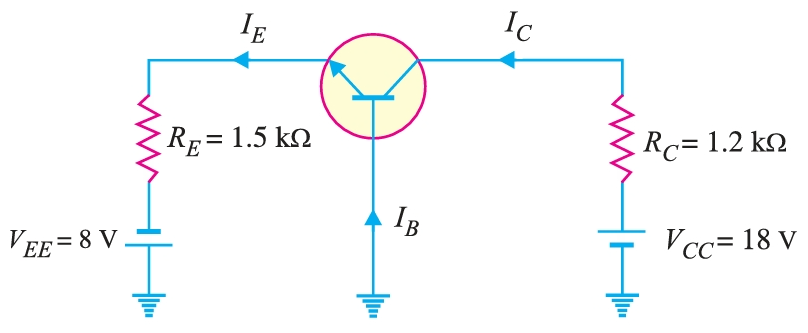
For the common base circuit, determine \(I_{C}\) and \(V_{CB}\). Assume the transistor to be of silicon.
Figure 2.
Find the value of \(\beta\) if (a) \(\alpha = 0.9\), (b) \(\alpha = 0.98\) and (c) \(\alpha = 0.99\)
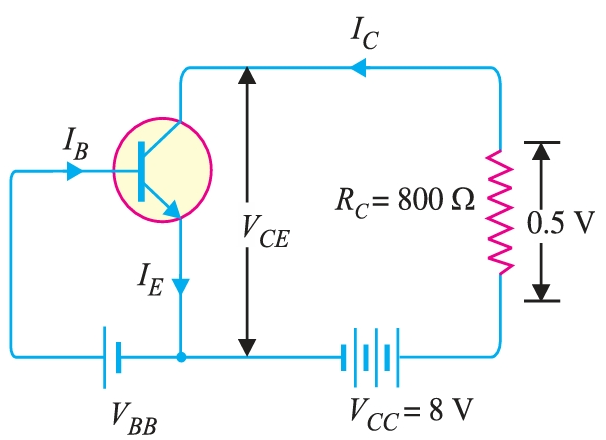
A transistor is connected in a common emitter (CE) configuration, in which the collector supply is \(8\,\text{V}\), and the voltage drop across the resistance \(R_{C}\) connected in the collector circuit is \(0.5\,\text{V}\). The value of \(R_{C} = 800 \,\Omega\). If \(\alpha = 0.96\), determine: collector-emitter voltage and base current.
Figure 3.
An \(npn\) transistor at room temperature has its emitter disconnected. A \(5\,\text{V}\) voltage is applied between the collector and the base. With a collector positive, a current of \(0.2 \,\mu\text{A}\) flows. When the base is disconnected, and the same voltage is applied between collector and emitter, the current is found to be \(20 \,\mu\text{A}\). Find \(\alpha\), \(I_{E}\), and \(I_{B}\) when the collector current is \(1\,\text{mA}\).
The collector leakage current in a transistor is \(300 \,\mu\text{A}\) in \(CE\) arrangement. If now the transistor is connected in a \(CB\) arrangement, what will be the leakage current? Given that \(\beta = 120\).
For a certain transistor, \(I_{B} = 20 \,\mu\text{A}\); \(I_{C} = 2 \,\text{mA}\) and \(\beta = 80\). Calculate \(I_{CBO}\).
A transistor has the following ratings: \(I_{C (\text{max})} = 500 \,\text{mA}\) and \(\beta_{max} = 300\). Determine the maximum allowable value of \(I_{B}\) for the device.
In \(CE\) configuration, if the collector current changes from \(2 \,\text{mA}\) to \(3\,\text{mA}\) in a transistor when collector-emitter voltage is increased from \(2\,\text{V}\) to \(10\,\text{V}\), what is the output resistance?
A change of \(200 \,\text{mV}\) in base-emitter voltage causes a change of \(100 \,\mu\text{A}\) in the base current. Find the input resistance of the transistor in the \(CE\) configuration.
The maximum power dissipation of a transistor is \(100\,\text{mW}\). If \(V_{CE} = 20\,\text{V}\), what is the maximum collector current that can be allowed without destruction of the transistor?
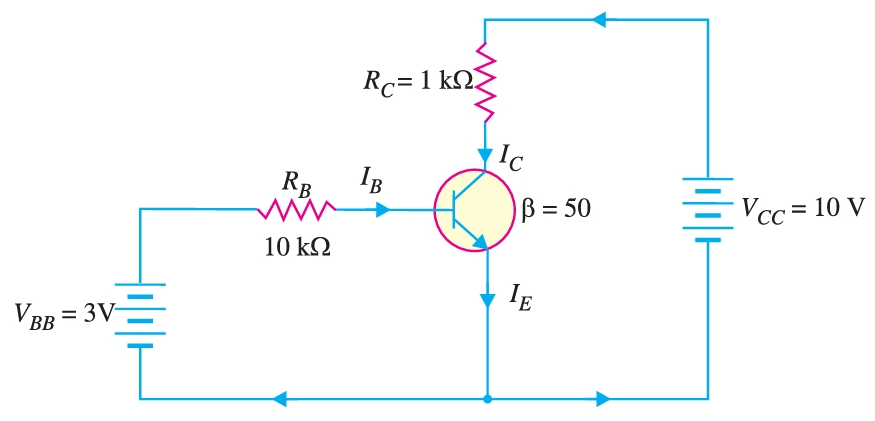
Determine whether or not the transistor is in saturation. Assume \(V_{\text{knee}} = 0.2\,\text{V}\).