Teacher: Prof P. M. Sarun • NPHC206 • WINTER - 2025-2026 • Last updated:
Questions
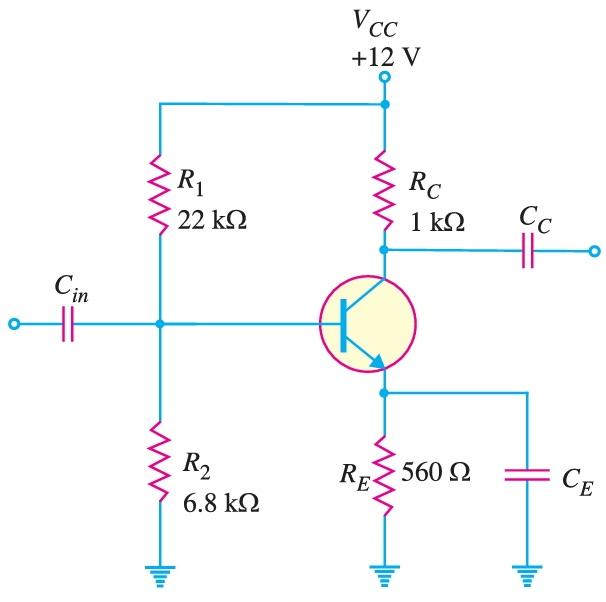
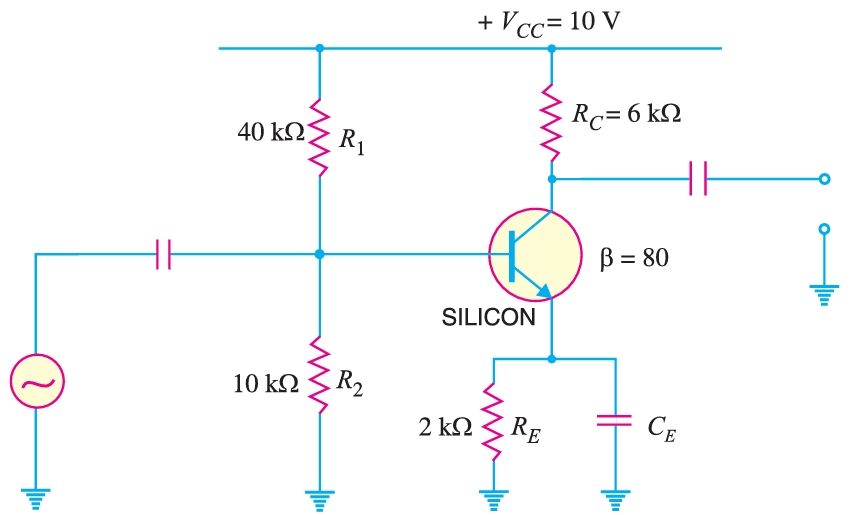
The amplifier is to operate over a frequency range from \(2 \,\text{kHz}\) to \(10 \,\text{kHz}\), determine a suitable value for the emitter bypass capacitor.
Figure 1.
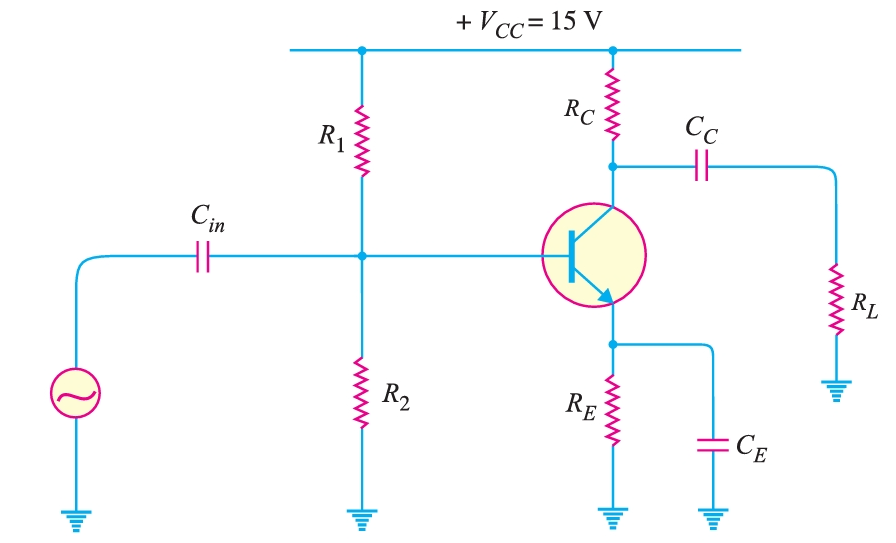
For the \(Si\) transistor amplifier shown, \(R_{1} = 10 \,\text{k}\Omega\), \(R_{2} = 5 \,\text{k}\Omega\), \(R_{C} = 1 \,\text{k}\Omega\), \(R_{E} = 2 \,\text{k}\Omega\) and \(R_{L} = 1 \,\text{k}\Omega\). Draw the a.c. load line.
Figure 2.
In the transistor amplifier shown in question 2, \(R_{C} = 10 \,\text{k}\Omega\), \(R_{L} = 30 \,\text{k}\Omega\) and \(V_{CC} = 20 \,\text{V}\). The values \(R_{1}\) and \(R_{2}\) are such so as to fix the operating point at \(10\,\text{V}\), \(1\,\text{mA}\). Draw the d.c. and a.c. load lines. Assume \(R_{E}\) is negligible.
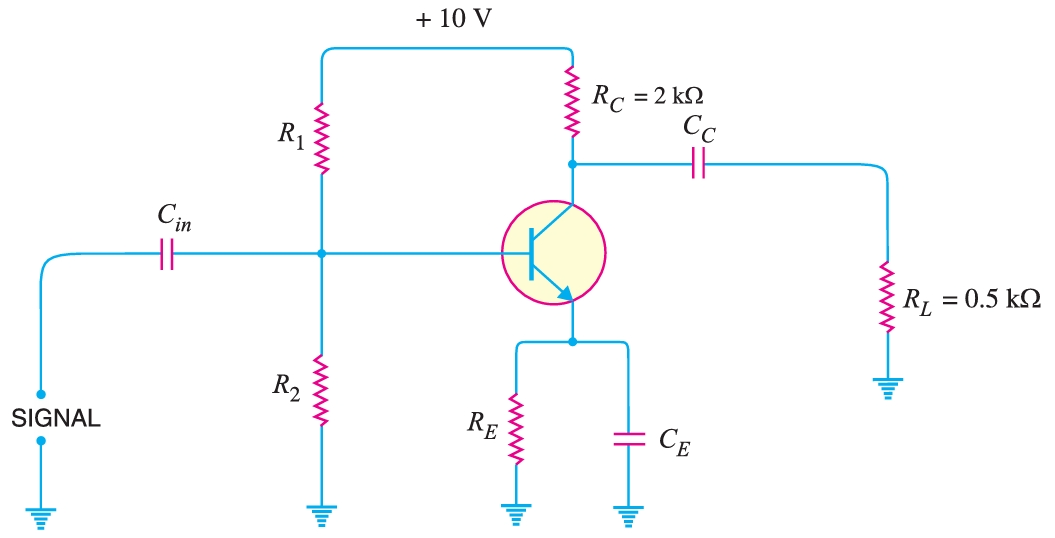
In the circuit shown, find the voltage gain. Given that \(\beta = 60\) and input resistance \(R_{in} = 1 \,\text{k}\Omega\).
Figure 3.
In the circuit shown in question 4, if \(R_{C} = 10 \,\text{k}\Omega\), \(R_{L} = 10 \,\text{k}\Omega\), \(R_{in} = 2.5 \,\text{k}\Omega\), \(\beta = 100\), find the output voltage for an input voltage of \(1\,\text{mV r.m.s}\).
In a transistor amplifier, when the signal changes by \(0.02\,\text{V}\), the base current changes by \(10 \mu\,\text{A}\) and collector current by \(1\,\text{mA}\). If collector load \(R_{C} = 5 \,\text{k}\Omega\) and \(R_{L} = 10 \,\text{k}\Omega\), find: (i) current gain (ii) input impedance (iii) a.c. load (iv) voltage gain (v) power gain.
The transistor has \(\beta = 50\). Find the output voltage if input resistance \(R_{in} = 0.5 \,\text{k}\Omega\).
Figure 4.
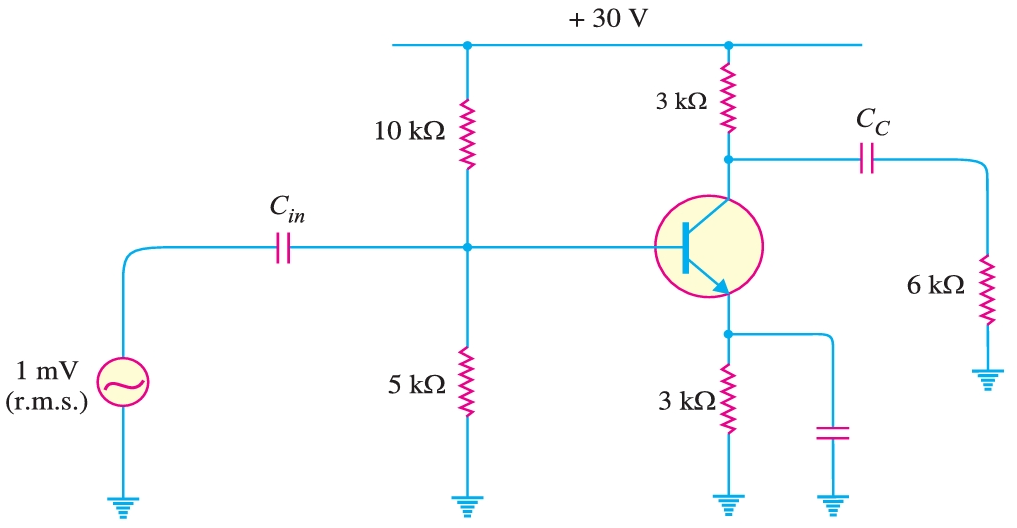
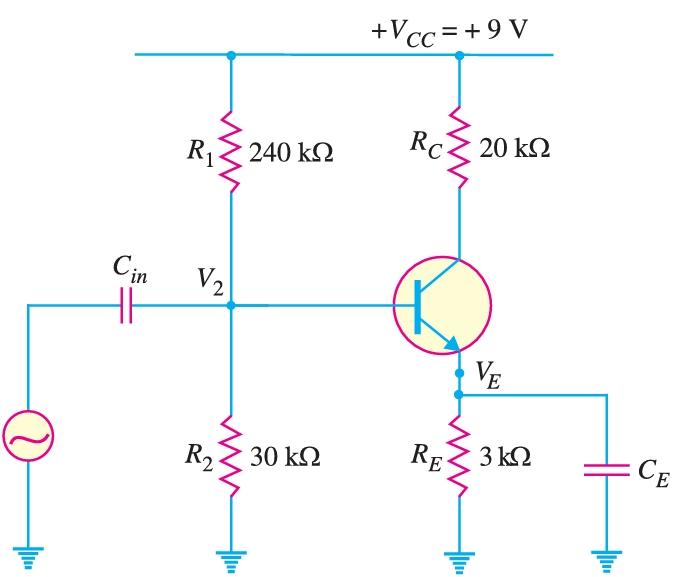
Determine the ac emitter resistance for the transistor circuit shown
Figure 5.
For the amplifier circuit shown in question 8, find the voltage gain of the amplifier with (i) \(C_{E}\) connected in the circuit (ii) \(C_{E}\) removed from the circuit.
A load of \(6 \,\text{k}\Omega\) is connected (with \(C_{E}\) connected) to the
collector terminal through a capacitor in question 8, what will be the voltage gain of the amplifier?
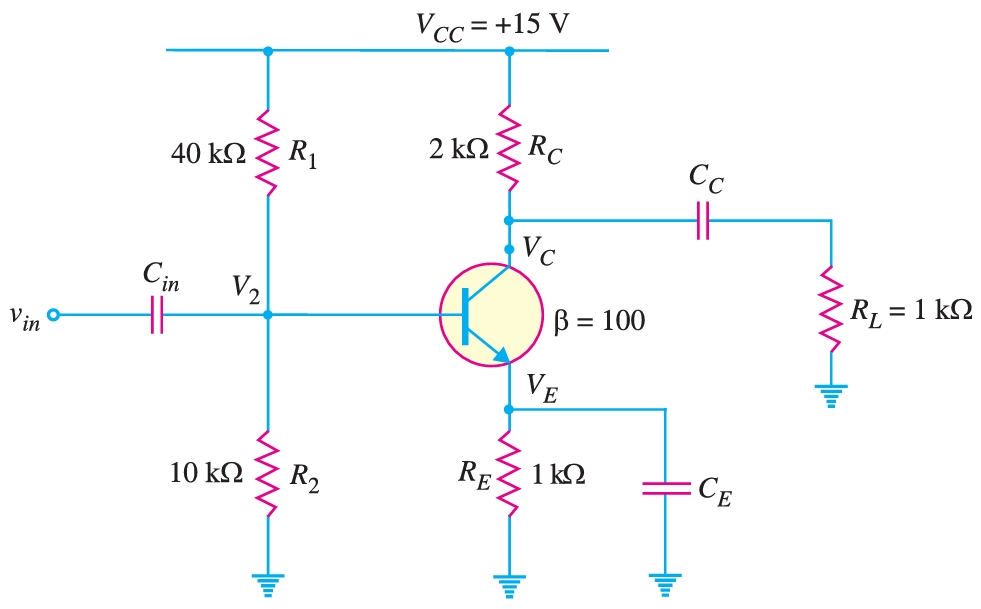
For the circuit shown, find (i) a.c. emitter resistance (ii) voltage gain (iii) d.c. voltage across both capacitors.
Figure 6.
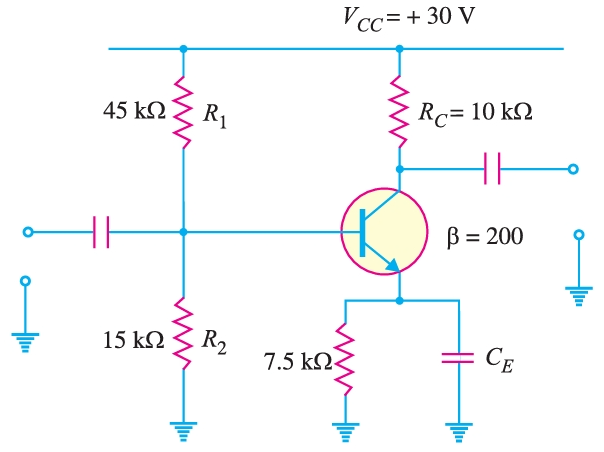
For the circuit shown, find (i) the d.c. bias levels (ii) d.c. voltages across the capacitors (iii) a.c. emitter resistance (iv) voltage gain and (v) state of the transistor.
Figure 7.
An amplifier has a voltage gain of \(132\) and \(\beta = 200\). Determine the power gain and output power of the amplifier if the input power is \(60 \mu\,\text{W}\).
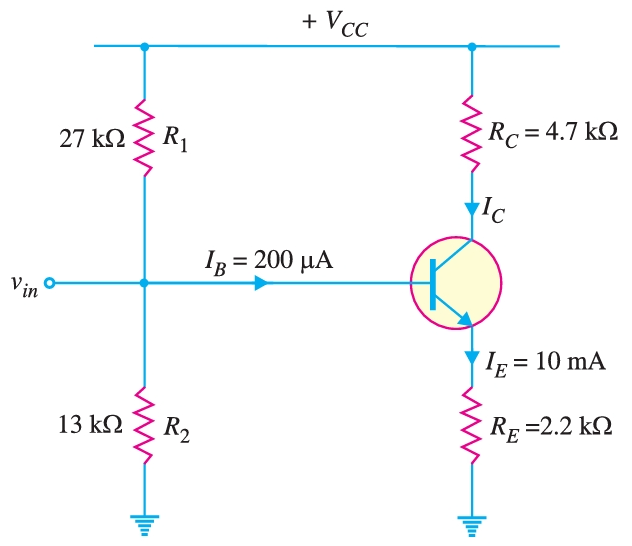
For the circuit shown, determine (i) the current gain (ii) the voltage gain and (iii) the power gain. Neglect the a.c. emitter resistance for the transistor.
Figure 8.
Determine the input impedance of the amplifier circuit.
Figure 9.
An amplifier has an open circuit voltage gain of \(1000\), an input resistance of \(2 \,\text{k}\Omega\) and an output resistance of \(1 \,\Omega\). Determine the input signal voltage required to produce an output signal current of \(0.5 \,\text{A}\) in \(4 \,\Omega\) resistor connected across the output terminals.
An amplifier has an open circuit voltage gain of \(1000\), an output resistance of \(15\,\Omega\) and an input resistance of \(7 \,\text{k}\Omega\). It is supplied from a signal source of \(\,\text{e.m.f.}\, 10 \,\text{mV}\) and internal resistance \(3\,\text{k}\Omega\). The amplifier feeds a load of \(35 \,\Omega\). Determine (i) the magnitude of output voltage and (ii) power gain.
An amplifier, when loaded by \(2 \,\text{k}\Omega\) resistor, has a voltage gain of \(80\) and a current gain of \(120\). Determine the necessary signal voltage and current to give an output voltage of \(1 \,\text{V}\). What is the power gain of the amplifier ?